Get acquainted with the Russian alphabet
I was thinking of posting some Russian language tutorials once in awhile here on Baikalogy. However, first you need to get acquainted with the alphabet! Here it is:
to see some ah-mazing photography, nice video and more about incredible artist Jim Denevan, please follow thislink
then we must think of future generations,” he declared. “We must do everything to make sure this danger is not just minimized, but eliminated.”
if that is what Putin said, then why will BPPM be reopened?
read on:
from mcclatchydc.com
Posted on Wed, Apr. 07, 2010
Putin about-face on paper mill threatens freshwater treasure
Elena Agarkova | Institute of Current World Affairs
last updated: April 07, 2010 09:08:33 PM
BAIKALSK, Russia — The future of 20 percent of the world’s supply of pure fresh water is in jeopardy because a surprise decree by Russian Prime Minister Vladimir Putin will allow a heavily polluting pulp mill to reopen on the southern shore of Lake Baikal in southern Siberia.
Magnificent, almost pristine Lake Baikal, the “Pearl of Siberia,” is a source of national pride and awe, an icon for the Russian environmental movement, a World Heritage Site and the only natural area in Russia that’s protected by its own law. Many locals consider the enormous lake — at 12,248 square miles, it’s the size of Maryland and Delaware combined — sacred. Between its size, its 5,380-foot depth and its remarkable biodiversity, the lake’s fate has global significance.
The Baikalsk Pulp and Paper Mill is the only industrial enterprise that dumped waste directly into the lake, and the fight against its construction gave birth to the Russian environmental movement and emboldened public figures to speak out against the Soviet state.
Using chlorine to produce bleached cellulose, BPPM discharged as much as 4 million cubic feet of toxic waste into Lake Baikal annually. More than 6 million tons of solid waste accumulated in huge open-air pits near Baikal’s shore, in an active earthquake zone. The estimated costs of cleaning it up run into the millions of dollars.
The Russian government tried for almost 20 years to halt pulp production and convert the mill to other uses. In 2000, as Russia’s president, Putin ordered BPPM “to end discharge of toxic wastes into Baikal at the earliest possible date,” and in 2007 he declared the lake a national treasure and moved a proposed oil pipeline beyond its watershed.
The next year, the Russian government prohibited the production of pulp and paper on Baikal without a closed wastewater cycle.
“If there is even the smallest, tiniest chance of polluting Baikal, then we must think of future generations,” he declared. “We must do everything to make sure this danger is not just minimized, but eliminated.”
Last summer, Putin came to Baikal and took a dive to the bottom of the world’s deepest lake in a mini-submarine. Upon emerging, Putin declared Baikal to be “in good condition.” Then, however, he declared that the lake was almost unpolluted and hinted that the shuttered mill might reopen.
Putin’s change of heart came as a surprise, and opponents of his January decree say it’s a shortsighted attempt to protect the business interests of one wealthy and well-connected Russian oligarch at the expense of a unique and precious ecosystem.
Oleg Deripaska, described as close to the Kremlin who saw his fortune dwindle in the financial crisis, owns 51 percent of BPPM’s shares, and the Russian government owns the rest.
Environmentalists began to mobilize almost immediately, claiming that Putin’s decision is illegal under Russian and international law and asking the United Nations Economic and Social Council to decide whether Baikal should be considered endangered.
More than 34,000 people have signed a petition to Medvedev on a popular Irkutsk Internet news site alone, and late last month, hundreds of people in Irkutsk braved the Siberian winter to protest Putin’s decree.
As environmental groups across Russia raised the alarm, Irkutsk police raided Baikal Environmental Wave, a local environmental group that protested Putin’s decree, on suspicion that it was using pirated computer software. No one believed that, however.
“Two of the four policemen were from the Center for Fighting Extremism,” the group said. “They had a camera and asked us provocative questions, for example, ‘Do you participate in anti-government demonstrations?’ As they took a photograph of our student volunteer’s identification card, they told her that her career was over.”
Putin’s new amendments to the Law on Lake Baikal allow the production of cellulose, paper and carton without a closed wastewater system, as well as the storage and burning of waste on Baikal’s shores.
Environmentalists say the mill, built in 1966 and closed in 2008, shouldn’t be allowed to resume operations without an independent investigation of the existing conditions, and they point to the fact that two years ago the mill was at the epicenter of a strong earthquake.
Former workers report that because the owner didn’t invest in maintenance and repair, the mill’s equipment is dangerously worn out. Even a pro-mill representative of the Baikalsk city council who came to a news conference organized by local environmentalists described the mill as “a house that needs to be torn down that someone just decided to put siding on.”
The current director of BPPM said the enterprise would be “even more environmentally sound in the future than it was in the past.” The mill’s owners, however, recently admitted that the closed wastewater system never functioned properly, and said they’d need another three years to upgrade it.
The workers’ trade union, however, reports that the mill is signing contracts for only three to seven months of work, and critics say Putin acted mainly to give more budget money to Deripaska and to give him a chance to sell the mill.
“I am sure that the mill will never work,” said Vladimir Naumov, the president of a local investment fund and the founder of a charity fund called Baikal 3000. “Otherwise they can write off Siberia and Baikal entirely, because no one lives here, and no one cares.”
(Elena Agarkova was born in Moscow, received her bachelor’s degree in political science from Barnard College and graduated from the Georgetown University Law Center in 2001. She was a Legal Fellow at the Berman Environmental Law Clinic at the University of Washington School of Law. She clerked for Judge Cynthia M. Rufe of the U.S. District Court in Philadelphia, and practiced commercial litigation at the New York office of Milbank, Tweed, Hadley & McCloy LLP. The Institute of Current World Affairs provides promising individuals with an opportunity to develop a deep understanding of an issue, country, or region outside the United States and to share that understanding with a wider public.)
an American(and local for me-Eugene/Springfield)/Venezuelan team has just completed the first human-powered winter circumnavigation of Lake Baikal by mountain bikes! um, WOW! you can learn all about it here
follow the link at the end and have a look at Baikal Wave’s blogspot for yourself. also, please consider donating to Baikal Wave!
from Baikal Wave:
Tuesday, 6 April 2010
Rallies in defense of Lake Baikal appear all over Russia
On the 27th and 28th March, rallies in defense of Baikal were held in various cities all over Russia.
At 20:30 on the 27th March in Irkutsk, a flash mob showing their support for the defense of Baikal was organised to coincide with the ‘Earth Hour’. A group of approximately 40 young people laid burning decorative candles in the shape of Lake Baikal on the alsphalt floor, then doing the same to form a figure 60. This thus expressed support for the rallies and actions taking place throughout the country in defense of Baikal and against the water pollution of the Lake by the Baikalsk Pulp and Paper Mill (BPPM).
On the 28th March, a trek across the frozen surface of Baikal took place under the slogan “Baikal without the BPPM”. Around 200 Irkutsk residents of various ages, both young to old, travelled the 13km distance from Old Angasolka to Slyudyanka across the ice of Lake Baikal. The crossing took place without incident, and as a sign of protecting Lake Baikal protesters held up flags bearing the event’s slogan and blue ribbons. The event was organized by the Baikal movement.
In Ulan Ude on the 27th March, a rally was held which combined formal presentations with artistic, creative and entertaining numbers. For example, participants actively expressed their emotions using marker pens on a “Wailing Wall’ and shared a pie called “Assets of the BPPM”, which was laid out and given to children at the event. At the end of the rally, participants held Chinese lanterns bearing candles and the symbol of Baikal – an Apple. During the rally, 500 signatures were collected in an appeal to UNESCO, the Government and the President, supporting the adopted resolution of the activists.
On the 27th March, 800 people gathered at a rally in St. Petersburg. The event opened with the words of Vladimir Putin: “If there is even the slightest chance of contaminating Lake Baikal, we must do everything possible not to simply minimize this danger, but to remove it altogether”. These were the words uttered in 2006 by the then President, who at the time decided to relocate a planned oil pipeline away from the shore of Baikal. Four years later, in January 2010, Putin signed a decree authorizing the discharge of waste water of the Baikal Pulp and Paper Mill into the Lake. At the rally, toilet paper was collected, symbolising that with which the authories wish to destroy Lake Baikal. Petersburgers sacrificed around 200 rolls of toilet paper in total. The collection of rolls was intended by the organizers to be sent to Vladimir Putin, the author of the decree which allows the discharge of sewage into Baikal.
On the 28th of March, a large rally-concert was organised in Moscow by the coalition of Non-Governmental Organisations “For Baikal!”, which brought together several hundred residents in the capital. Similar actions were held in Petrazavodsk, Chelyabinsk and Barnaul.
Calls to protect the lake were also supported by the actor Lev Prygunov and Viktor Bychkov, the writer Valentin Rasputin, music critic Artem Troitsky, leader of the group DDT Yuri Shevchuk, Ilya “Devil” (of the band “Pilot”) and Michael Nowicki (of the group ‘SP Babai’). As well as this, over the past two weeks a petition for the defense of Baikal as been sent to the Director General of UNESCO Irina Side, and has been signed by more than 15,000 Russians.
It is worth recalling that on the January 13, 2010, Vladimir Putin signed Decree No.1 of the Russian Government, which allowed for the dumping of waste from pulp and paper production directly into Lake Baikal. The decree also allowed for the building of new pulp and paper mills and the burning of hazardous waste on the shores of Lake Baikal.
You can find more information about the environmental risks associated with the BPPM, the social and economic situation in the region, and other information about Lake Baikal at the following sites (All in russian);
http://savebaikal.ru
http://community.livejournal.com/baikalmovement
http://babr.ru.
visit Baikal Wave
Video Sunday will be on hiatus while i rework the site a little bit. Enjoy the last part of Trans-Siberian rail PBS series.
Continue Reading…
The glass is half full – the paper mill is closed for good!
Some good news- depending on how you look at it- comes from the dreadful economy:

By MIKE ECKEL, Associated Press Writer Mike Eckel, Associated Press Writer – Fri Mar 13, 11:47 am ET
MOSCOW – For decades, it spewed chemicals and foul effluent into the pristine waters of Lake Baikal in Siberia.
For decades, environmentalists pushed for its closure, calling it a shameful blight on the world’s largest fresh water lake.
Now, 43 years after its construction, the Baikal Pulp and Paper Mill is closing for good in a breakthrough for Russia’s environmental movement, which many believe began with the long battle over the factory.
The owner, Kontinental Management, said Friday that the plant, which temporarily halted production in October, will not restart operations, for financial and technological reasons. Shareholders, which include the federal government and the struggling industrial conglomerate Basic Element, will meet in coming weeks to decide exactly what to do with it, the company said.
“Unfortunately, time is already up for the (factory) and the plant will be never be able to resume production,” the company said in a statement posted on its Web site.
“It’s good news, of course, though it wasn’t completely unexpected,” said Marina Rikhvanova, a veteran activist who heads the environmental group, Baikal Wave. Continue Reading…
Happy Birthday, Valentin Rasputin!
Valentin Rasputin was born March 15, 1937.

from “Siberia, Siberia”:
“The normal concept of beauty fits Baikal least of all. What we take for beauty is an impression of a different type, like something that hangs above the horizon of our sensitivity, No matter how often you’ve been to Baikal, no matter how well you know it, each new encounter is unexpected and requires effort on your part. Each time you seemingly have to raise yourself to a certain height again and again in order to be on the same plane, in order to see and hear it.
Not everything, as we know, has a name. It’s impossible to give a name to the regeneration that occurs in people when they’re near Baikal. There’s no need to remind anyone that for this to take place a person must have a soul. And here stands and looks around, is filled with something and carried off somewhere, and can’t understand what’s happening to him. Like a fetus in it’s mother’s womb, he passes through all the evolutionary stages of human development and, spellbound by the ancient, mighty unfolding of this miracle, he experiences the timeless tidal feeling of the powers that created humankind. ….”
Yep, it’s Video Sunday!
I was thinking you might want to watch this PBS series about the Trans-Siberian Railway. There are 12 episodes. Enjoy.
Video Sunday!
enjoy:
Continue Reading…
All New Category: Video Sunday!
who doesn’t love a good video?
Video Sunday will feature a few videos I have found that I want to share with you, cause you are so nice. Enjoy!
O.K., sometimes it will actually be Video Early Monday Morning.
Spotlight On: Nerpa
The loveable little Nerpa-my absolute favorite animal! more to come about these “Sacred Sea dogs”….

Spotlight On: Tahoe-Baikal Institute Summer Exchange Program–DEADLINE 13 FEBRUARY 2009!

Tahoe Baikal Institute is still accepting applications for its 10 week exchange program to both Lake Baikal and Lake Tahoe. Explore here
Get your application in–and good luck!
Spotlight on: Baikal Environmental Wave
I am focusing on Baikal Environmental Wave because their work is vital to the protection of Lake Baikal. I have been following their work from afar for oh so many years and have long admired all the folks at Baikal Wave for their dedication and passion and action for Lake Baikal. They are focusing especially on action to close the Baikalsk Pulp and Paper Mill permanently and the uranium enrichment plant in Angarsk.
Learn a little about Baikalsk Pulp and Paper Mill from Pacific Environment here
Take a look around the Baikal Wave site and learn more about all that they do!
learn more about the uranium enrichment center in Angarsk from Baikal Wave’s website here
Marina Rikhvanova (my hero, though she doesn’t know) has earned a Goldman Prize for her work for Lake Baikal.
Watch the video:
Spotlight on: Great Baikal Trail
The Great Baikal Trail is a great non-profit organization that is dedicated to promoting sustainable development around Lake Baikal. This is achieved through trail building “work-cations” about two weeks in length that focus on building a comprehensive system of accessible trails completely around the magnificent Lake Baikal. The projects bring together people from many different countries with an emphasis on environmental education for all ages, respect for indigenous populations, sustainable business, development and tourism, respect and appreciation of nature, and so much more.
In Spring and Summer 2008, GBT had over 23 projects with over 400 Russian and international volunteers. What a wonderful way to discover or re-discover Lake Baikal. There are no age restrictions and even some camps geared toward families with young children! There is so much more to discover about this wonderful organization, I strongly encourage you to visit their website to learn all about the important work they are doing over there!
Go here and maybe even sign up!
and here’s a peek at just one of the projects (from 2006):
A few words about this new site:
This site is intended to reflect my love for Lake Baikal.
You can find out more about why i even feel this way about Lake Baikal when I update my “about me” page. For now, there will be about 3 main categories of posts:
–Baikal Posts
as the name suggests, these are posts that have something to do with Lake Baikal.
–Russia News
the posts here are posts that i have found of news coming out of Russia. This category might also contain original articles about current events in Russia.
–Spotlight on:
this category will contain- at least weekly but quite possibly daily- features about something interesting or important that I think you, awesome reader, should know about.
All of these categories would warmly welcome comments!
There are lots of other little side(bar) trips you can take along the way on your journey to and through Lake Baikal. So, please stay tuned ….and welcome!
heather
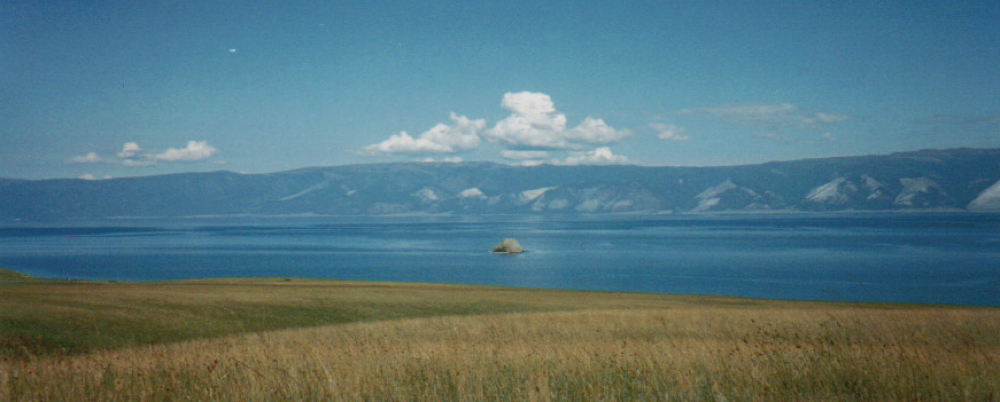
Lake Baikal is phenomenal.
Let me introduce you. The “Sacred Sea” is located in south central Siberia(that’s in Russia) just above the Mongolian border. It is a crescent moon-shaped “ladle” filled with 20% of the Planet Earth’s fresh water. Lake Baikal contains more water than in all the North American Great Lakes combined. About 336 rivers and streams flow into Lake Baikal but only one river flows out-the Angara River, located on Baikal’s NW shore. If all of the inflow to Baikal were to suddenly stop, it would take over 300 years to drain it. Clearly, Baikal is mighty.
O.K. But that doesn’t even begin to tell it. Baikal is ANCIENT. 25 million years old ancient. Wait….think about that. Twenty. Five. Million. Years. OLD. See, this is where one starts to get goose bumps just thinking about Baikal sitting there…hearing that silence that was there 25 million years ago. And Baikal still possesses it- it is a part of the lake and is there for us to hear it like a giant seashell that, when held to ear, imparts the songs and wisdom of the sea to its audience, Baikal has that silent wisdom to impart. I know because i have heard it- i still hear it because it never leaves the heart that hears it. You can almost imagine that Baikal has one leg in the past, so to speak, and one leg in the present (or future). Simply put, Lake Baikal is not just water.
So Baikal also has a whole bunch of lucky creatures that carry with them the past wisdom, the silent patience. In fact, Baikal has about 1500 species of plants and animals with about 80% of them endemic to Lake Baikal (they exist nowhere else on the planet! just at Baikal). One if the standouts is the Nerpa…..
Baikal microbes could help clean up oil spills.
from the Telegraph U.K.:
Oil spills could be cleaned up with the help of organisms that grow at the bottom of the world’s deepest lake, scientists hope.
Last Updated: 5:12PM GMT 01 Jan 2009
They are investigating how microbes ‘eat’ naturally occurring crude oil that seeps into the bottom of Lake Baikal in Siberia.
Dr Mikhail Grachyov, an expert on the flora and fauna of the 5,400ft-deep lake, said: “Baikal has microbes that absorb this oil so it does not spread through the lake. This could have huge implications for environmental disasters.”
The scientists believe that the microbes convert the crude oil into methane and other by-products, but they do not yet understand how.
Dr Grachyov said: “It is important that we study these processes more thoroughly.”
Samples that were gathered in two mini-submarines will be analysed over the coming years.
In 1996, hundreds of sea birds were killed along with fish and other marine wildlife when the Sea Empress oil tanker ran aground off the Pembrokeshire coast, spilling 72,000 tonnes of crude.
Dr David Santillo, senior scientist with the Greenpeace Research Laboratories at the University of Exeter, said: “Further investigation of these unusual microbial communities in Lake Baikal will be valuable.
“However, while microbial action might help deal with some oil spills, we need to place far more emphasis on preventing such spills from happening in the first place.”
.
.
.
.
.
.
.
.
.
.
.
.
please take a look at my old site here to read posts that came before this.
I have always had dreams of Lake Baikal. So I followed them. You can contact me at heather (at) baikalogy (dot) com. thanks, enjoy!

Baikal, my cat! He is 16 years old. Isn’t he gorgeous?